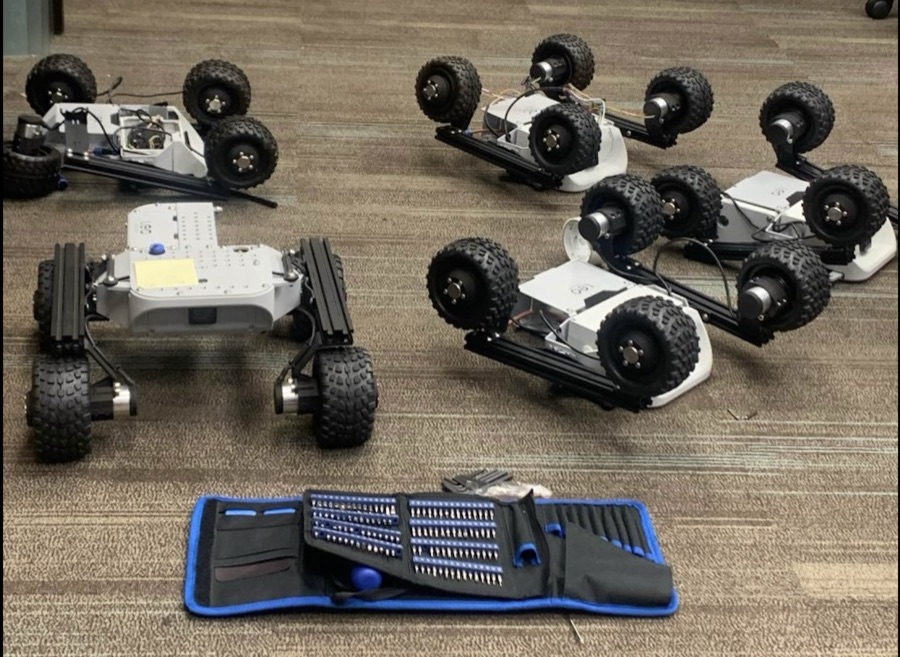
Rover AirTag: person-following robot
Programmed a four-wheel rover to autonomously follow a person in real time using AirTag-based localization, building out the tracking and motion-control loop end to end on real hardware.
HardwareRaspberry Pi 4
Research
I study how to combine physical models with machine learning so that a controller stays accurate where it has data and reliable where it doesn't. Most of my papers sit where these three threads meet.
Learning how a system behaves from data, with physics built into the model so it holds up when data is scarce.
Measuring how far a learned model can be trusted, so a controller can lean on physics once the data runs out.
Using the model to act: differentiable MPC and reinforcement learning that hold up under model error.
IROS 2026
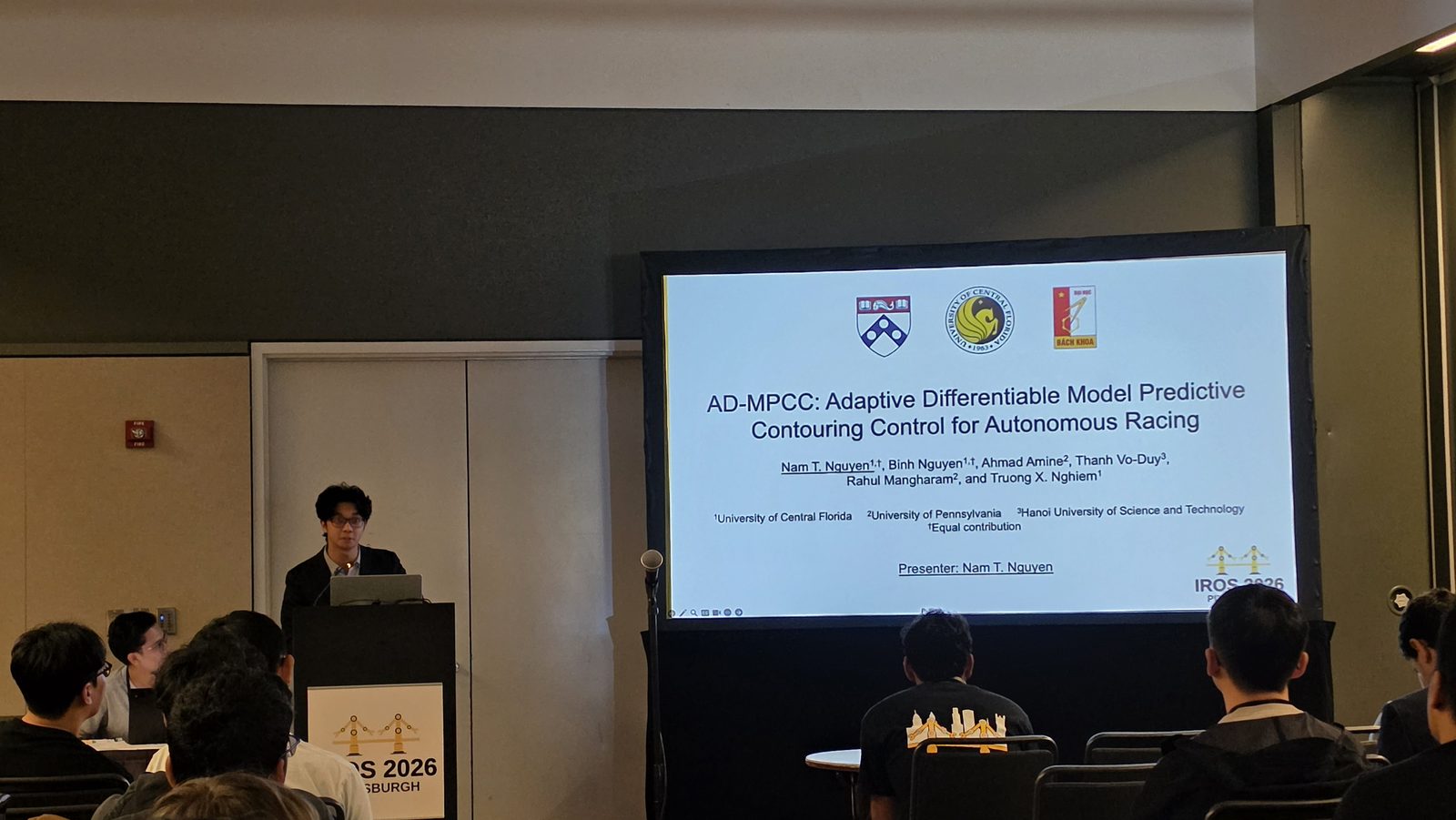
Online tire–road estimation paired with a differentiable MPC that tunes its own cost weights. It reaches 15% faster lap times than standard MPC in a full-size race-car simulator.
This paper presents Adaptive Differentiable Model Predictive Contouring Control (AD-MPCC), a framework for autonomous racing that integrates differentiable MPCC with online parameter estimation to handle varying road-surface conditions. For online parameter estimation, we leverage a parameterized Pacejka Magic Formula together with a regularized moving-horizon estimation scheme with exponentially decaying weights to capture road interactions and update parameters in real time. Furthermore, we propose a differentiable MPCC (Diff-MPCC) framework that enables optimal adjustment of objective weights based on predefined long-horizon performance costs. Simulation results demonstrate that AD-MPCC reliably ensures safety and achieves faster lap times compared to baseline controllers in both single-surface and multiple-surface scenarios.
Submitted
An add-on uncertainty quantification module for pre-trained hybrid physics-informed models. It estimates the model's epistemic uncertainty and uses it to set how much the physics and the learned part each contribute to a prediction. In model predictive control of a racing car, a quadrotor, and a Franka manipulator it outperformed four baselines, cutting quadrotor position error by 21% without disturbance and 13% under high noise versus the hybrid baseline.
CDC 2026
Learns port-Hamiltonian dynamics without the usual convexity constraint, and preserves the stability of multiple isolated equilibria rather than a single one.
This paper investigates the problem of data-driven modeling of port-Hamiltonian systems while preserving their intrinsic Hamiltonian structure and stability properties. We propose a novel neural-network-based port-Hamiltonian modeling technique that relaxes the convexity constraint commonly imposed by neural network-based Hamiltonian approximations, improving the expressiveness and generalization capability of the model. The proposed method also incorporates information about stable equilibria into the learning process, allowing the learned model to preserve the stability of multiple isolated equilibria rather than being restricted to a single equilibrium as in conventional methods.
IEEE Access 2026
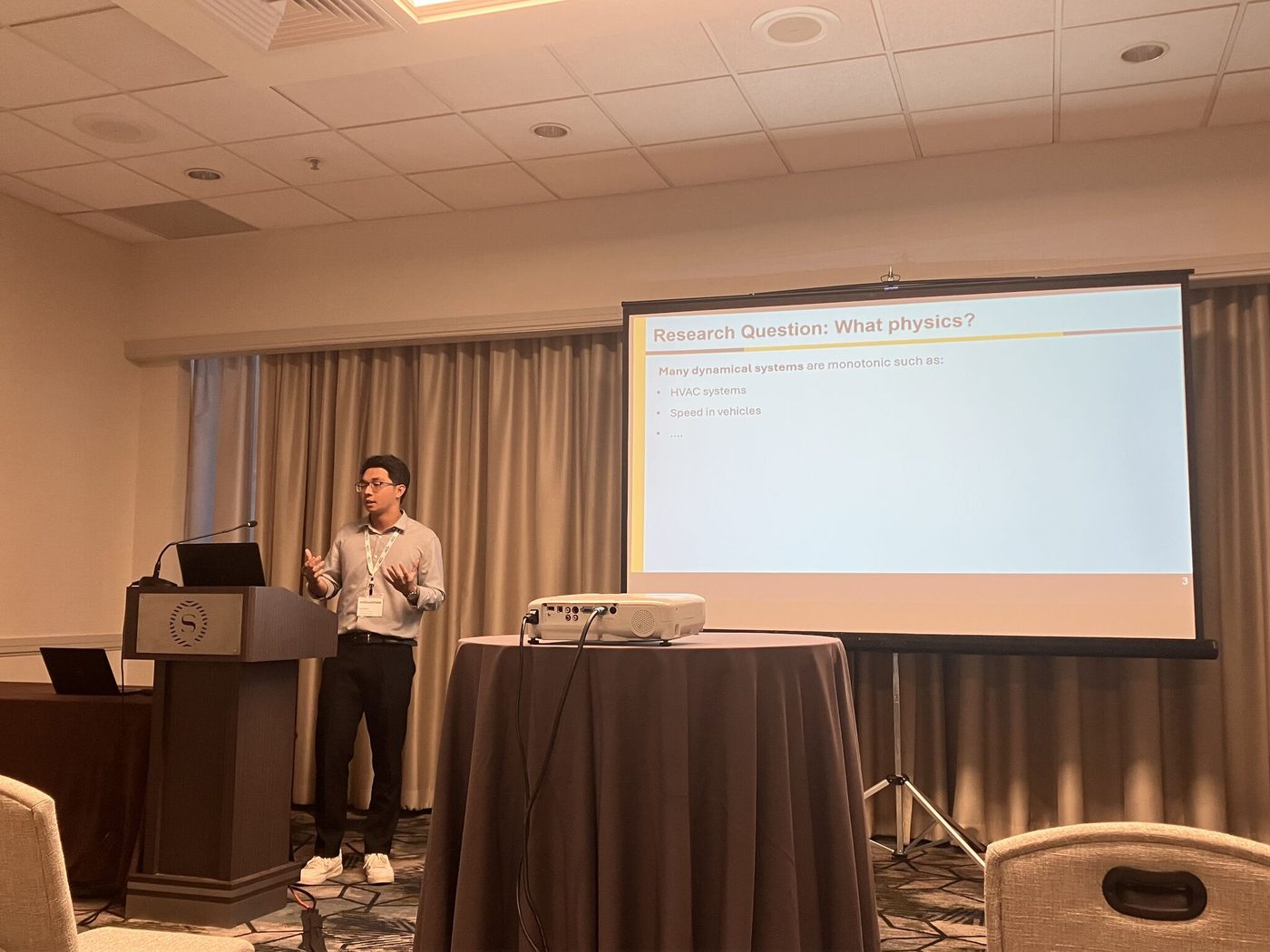
Thirteen modeling techniques benchmarked on real-world HVAC data. Physics-informed models come out ahead, most clearly when data is limited, unreliable, or noisy.
Accurately identifying HVAC dynamics is challenging due to the system's nonlinearities and variations across building types. This paper investigates physics-informed machine learning (PIML) techniques that incorporate three physical properties — monotonicity, boundedness, and system structure — benchmarked against physics-agnostic machine learning and gray-box modeling on real-world HVAC data across thirteen modeling techniques. Results demonstrate that PIML models outperform physics-agnostic models in predicting HVAC temperature dynamics, especially when training data is limited, unreliable, or noisy.
Submitted
Fourteen active-learning strategies compared for system identification on the BOPTEST simulator, with error reductions of up to 54% over passive learning.
Optimal experimental design (OED), realized in this work through active learning (AL), determines which experiments to conduct in order to collect informative data for building energy system identification, rather than relying on standard approaches such as uniformly random sampling. This paper proposes a systematic comparison of OED via AL for building energy system identification, with a particular focus on HVAC thermal dynamics, investigating fourteen AL techniques across a deterministic feedforward neural network and a stochastic Gaussian process. Evaluated on the high-fidelity building simulator BOPTEST, AL-based models generally outperform models trained via passive learning, achieving error reductions of up to 54%.
ACC 2025
A neural network used as the first-order term of a Taylor expansion, with monotonicity built in. It gives 25% higher multi-step accuracy and was then run inside MPC on a real MIMO system.
HardwareArduino temperature-control lab
We propose a novel method for system identification by integrating a neural network as the first-order derivative of a Taylor series expansion instead of learning a dynamical function directly. This approach, called Monotonic Taylor Neural Networks (MTNN), ensures monotonic properties of dynamical systems by constraining the conditions for the neural network output to be either always non-positive or non-negative. MTNN demonstrates better performance than unconstrained methods on real-world HVAC and TCLab data, and shows strong performance in an actual model-predictive-control application for a nonlinear MIMO system.
VPPC 2023
Wheel-slip control for electric vehicles with a fuzzy controller that adapts to road conditions, cutting wheel slip ratio by 23% during acceleration.
HardwaredSPACE DS1103 and TI C2000, hardware-in-the-loop
A wheel slip control algorithm for electric vehicles is proposed by considering the vehicle as an equivalent inertial system. Based on the monotonicity of the algorithm, a fuzzy controller is incorporated so that the wheel slip control can adapt to actual road conditions. Its performance is verified by comparative simulations against baseline anti-slip methods across different road conditions and vehicle velocities.
Programmed a four-wheel rover to autonomously follow a person in real time using AirTag-based localization, building out the tracking and motion-control loop end to end on real hardware.
HardwareRaspberry Pi 4

Built a real-time face-recognition pipeline with YOLOv3, YOLOv5, and YOLOv8, from camera input to bounding-box detection with per-person confidence scores.
HardwareNVIDIA Jetson, RGB-D camera

Built a smart home system with an MQ5 gas sensor and motorized door control, integrated with Blynk and ThingsBoard dashboards, email alerts, and Siri voice commands for remote monitoring.
HardwareESP8266 microcontroller
Taught and recorded math tutoring sessions for students through the Learning Support Club (CLB Hỗ trợ Học tập) YouTube channel, helping peers build stronger fundamentals in mathematics.